
How Older Adults Can Improve Balance at Home and Reduce Their Risk of Falls
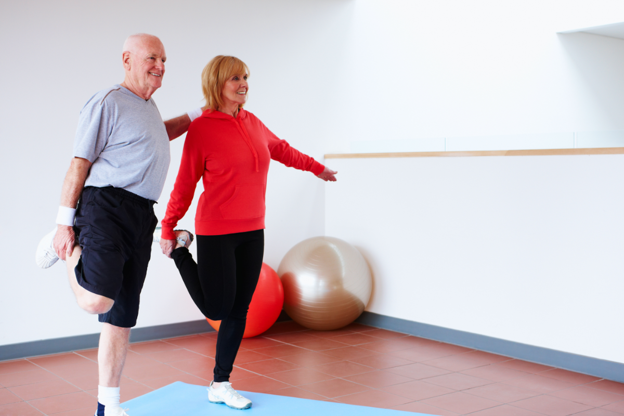
Many people may not see the big deal with wobbling while standing to walk, feeling a lack of confidence when using the stairs, or needing to hold onto something while walking across the room.
But you should pay more attention to how you are standing when you get up, because you may be one of the first people to notice that your balance isn’t what it was before, even though you may not believe that you are getting older and losing the ability to be independent.
The positive side is that you can retrain your balance with a few simple exercises and by restructuring your home environment.
Why Balance Can Change With Age
Balance is a combination of many things. It is the combination of vision, strength, the inner ear and brain, and the sense of balance of your joints and muscles. The combination of loss of vision or strength, certain medical conditions, prolonged sedentary behavior, certain medications, and dizziness can cause a lack of balance.
Unfortunately, poor balance is not something you should simply accept. The National Institute on Aging recommends incorporating balance exercises into your routine, such as standing on one foot, walking heel-to-toe, and practicing tai chi, which can improve your balance and help prevent future falls.
It is not about performing complicated movements or standing completely still for an extended period of time. The purpose of these activities is to increase your confidence when performing more advanced movements such as turns, reaching, stepping, and getting up from a chair.
Simple Balance Exercises to Start With
Before you start, choose a brightly lit area. Stand beside your solid kitchen counter or a heavy table. Do not choose a lightweight chair because it may move. Put on your supportive shoes and, if needed, ask someone to stand by you.
You should check with your doctor or physical therapist if you have had a recent fall, are experiencing severe dizziness, or have a medical condition affecting your ability to move.
Supporting Single-Leg
The muscles needed for balance and coordination are tested with this activity.
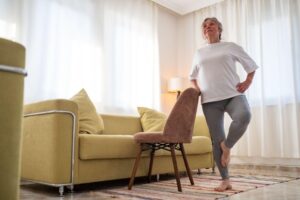
- Stand behind a solid chair and grab the back of the chair.
- Slowly lift one foot a few inches off the ground.
- Maintain this position for 5 to 10 seconds if comfortable.
- Gently lower your foot and then repeat on the other side.
- Do three repeats on each leg.
Once you are more comfortable, you can support with one hand rather than two.
Heel-to-Toe Walk
This activity helps you get used to moving forward while maintaining balance.
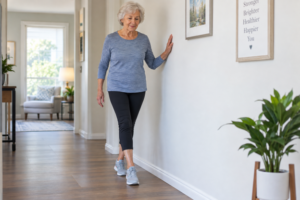
- Positioned next to a wall or walking on a flat surface.
- Put one heel directly in front of the other toes.
- Take a slow step forward.
- Repeat steps 2 and 3 for five to ten steps.
- Turn carefully to walk back and return to the starting point.
Keep one hand against the wall to give you balance. If this is too hard, you can simply lean against the wall with a counter and practice normal, slow walking.
Sideways Walking
You often lose balance when moving from side to side past furniture, but practicing this movement can help you control yourself better.
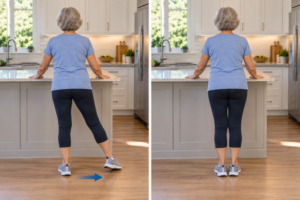
- Face a kitchen counter and hold it with both hands.
- Step slowly to the right with your right foot.
- Bring your left foot beside it.
- Continue for 5 to 10 steps.
- Repeat in the opposite direction.
To make the exercise easier, grip the counter with two hands, while to make it more difficult, grip with one hand.
Sit-to-Stand Practice
Getting up from the chair is usually not considered a balancing activity, so it may surprise you to learn that it requires a lot of control and stability.
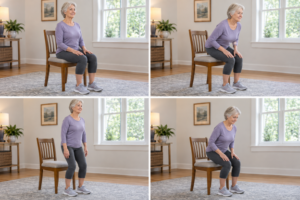
- With your feet flat on the floor, sit back on a sturdy chair.
- Go to the front of the chair.
- To get to a standing position, bend forward and push yourself up with your feet.
- Pause and slowly lower yourself back to a seated position.
- Do this five times. Pause as needed.
Use your hands on the armrests if necessary. Avoid pulling yourself up using a lightweight chair or walker that is not designed for that purpose.
A Few Minutes Regularly Is Better Than Overdoing It
Balance exercise can be done in minutes, not hours. According to NIA, one should aim for doing balance exercises at least three times a week to build and improve balance, along with other physical activities.
Do this for five to ten minutes when the kettle is on to boil or after brushing your teeth. Do the exercise slowly, and if you find it too difficult, lean on someone for support and shorten the range of motion. Always hold on with both hands to lower the difficulty of the exercise.
Stop if you feel pain, dizzy, or short of breath. Do not ignore any unusual sensations or falling feelings.
Tips for Fall Prevention at Home
Did you know decreasing your fall risk isn’t strictly about workouts? Home adjustments are needed as well:
- Improve lighting in areas around the stairs, hallway, and near the bathroom.
- Remove all loose-fitting rugs, clutter, and electrical cords.
- Install handrails on stairs and grab bars where needed.
- Place items frequently used in low-reach areas.
- Wear shoes and/or slippers with non-slip soles.
- If you experience lightheadedness, stand more slowly.
- Have your medications checked by your healthcare provider if you experience dizziness or drowsiness.
- Routine eye exams are needed. Verbalize your visual concerns to your doctor.
Conclusion
You don’t have to show off and dance like you used to. Improving balance is about feeling less uncertain when you get up to go to the kitchen, cross a door threshold, step in and out of bed, and even when you turn around.
Start with movements you can do today, hold onto something that will help support you, and go slowly. If your balance problems are new, worsening, and/or are accompanied by dizziness, go get some help instead of trying to take care of it yourself.
A few minutes each day, done consistently at home, can easily improve your confidence to move on your own.
About the author
Bob Bies is the founder and publisher of Seniors Fitness Circle, a resource dedicated to helping adults over 60 stay active, strong, and independent. His work focuses on making safe, structured movement accessible through practical, beginner-friendly fitness guidance.